
Liquid hydrogen is attracting growing interest as a route to decarbonising aviation, but integrating it into an aircraft involves far more than simply storing fuel at extremely low temperatures.
A Critical Review of Cryogenic Hydrogen Storage and Fuel-System Integration for Aviation, published in Renewable and Sustainable Energy Reviews, brings together expertise from the University of Bath, GKN Aerospace and collaborators across disciplines to examine the challenges of integrating liquid hydrogen into future aircraft.
In this Behind the Paper feature, lead author and UK-HyRES Hub Researcher Dr Rajan Jagpal reflects on the motivation behind the review, the questions that shaped the research, and what the team learned along the way.
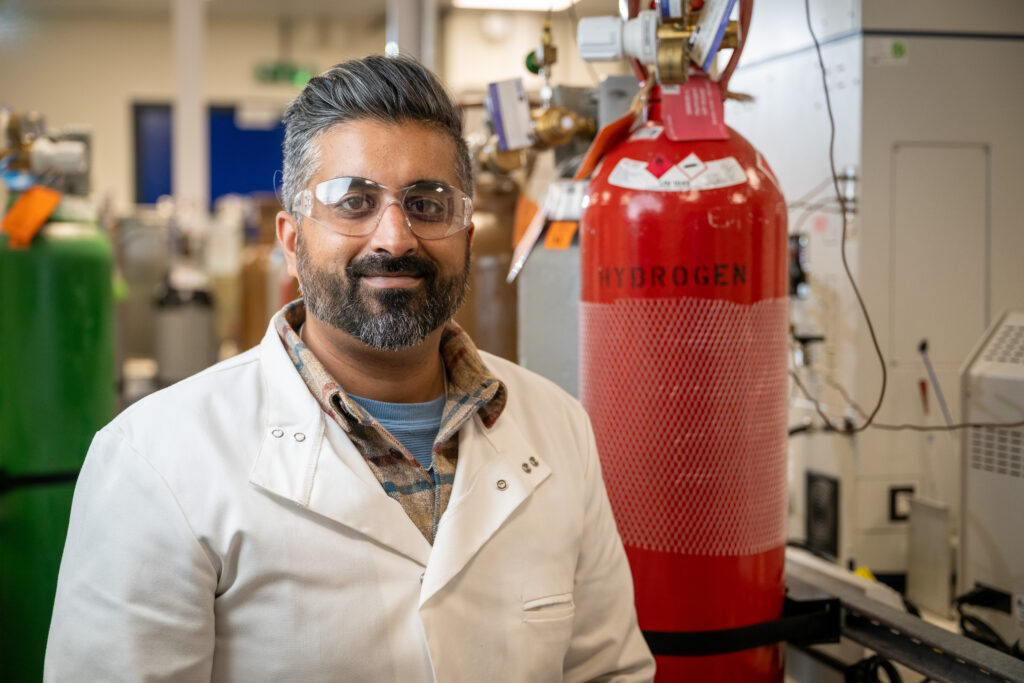
1. What is the actual problem this paper is trying to solve?
The question has shifted over the past decade.
It used to be whether liquid hydrogen could be kept cold, or whether an LH2 propulsion system could physically fit on an aircraft. We now know both are possible. The harder question is whether the whole system can remain predictable through years of operation on a real aircraft.
At the beginning, I imagined the review rather naively. I thought it would mostly be about keeping enough hydrogen cold. Keeping LH2 near 20 K (−253 °C) in a tank large enough to give useful range without making the aircraft too heavy is clearly important. But thanks to vacuum insulation, and decades of experience with other cryogenic systems, keeping the hydrogen cold turns out to be only part of the story.
An aircraft tank also has to deliver fuel while the aircraft is flying. It has to cope with changing fuel demand, turbulence, turning, ascent, descent and repeated thermal cycles, all inside a space-limited, safety-critical vehicle. That means it is no longer simply a container. It becomes an active cryogenic fuel system, with vacuum insulation, ullage, pressure control, valves, sensors, fuel conditioning, heat exchangers and certification all working together.
Looking back, I think we spent less time understanding the tank than understanding the state of the hydrogen as it moves through the aircraft. That turned out to be the more interesting problem. That way of thinking even changed how we presented the fundamentals, including making a clearer distinction between a vapour and a gas.
That’s why we present a phase diagram, developed under the guidance of Emeritus Professor Tim Mays, that clearly distinguishes vapour from gas. Surprisingly, that distinction is not presented particularly clearly in much of the existing literature.
2. Why did this need writing now?
Liquid hydrogen is increasingly being explored as a route to decarbonising aviation. In 2022, aviation accounted for around 2% of global CO2 emissions, and that’s projected to grow to as much as 20% by 2050 if we do nothing to change our technology or behaviour.
There was already a great deal of useful knowledge out there. The problem was that it lived in different places.
Some came from aircraft concept studies. Some came from space systems. Some from road tankers, ships and industrial cryogenics. Some simply came from conversations with people who had spent years working with these systems.
None of it transfers cleanly to an aircraft.
A road tanker can be heavy. A ship has more room to compromise on access and maintenance. A launch vehicle has a very different operating life. Aircraft have none of those luxuries. Mass, volume, reliability, maintenance and certification all have to work together, across thousands of flight cycles.
That made it surprisingly difficult to see the real research questions.
At Bath, the UK-HyRES and the ZENITH Partnership were already bringing together researchers from different disciplines alongside industrial partners. Everyone had part of the picture, but rarely the whole picture. We wanted the review to provide a common framework that people could challenge, improve and build on.
We started drafting it in autumn 2024 and spent the best part of a year refining it with the co-authors. That felt appropriate for a paper whose argument is partly that these systems cannot be rushed. We note that qualifying a new material or cryogenic architecture for aircraft use can take the best part of a decade.
The field doesn’t just need new materials.
It needs to understand what the materials and systems we already have do inside a real aircraft. Once we have that knowledge, we can optimise and develop innovations that have real impact.
3. What surprised you most while working on it?
Vacuum, honestly.
Professor Stephen Harrison pushed this point hard in our discussions, and it stayed with me.
The instinct is to think about a hydrogen leak as lost fuel. But in a vacuum-insulated tank, a small leak may matter far more because of what it does to the vacuum than because of the hydrogen it costs.
A poorer vacuum means more heat entering the system. More heat means more boil-off. More boil-off changes pressure control.
The paper therefore treats vacuum condition as part of the health of the whole fuel system, not something checked once during manufacture and then forgotten.
It changed how I read the literature.
The question stopped being, “How well does this component perform?”
It became, “What happens next because it performs that way?”
4. What makes this concrete rather than abstract?
The numbers help.
One Aerospace Technology Institute midsize aircraft concept discussed in the review carries 279 passengers and around 16,700 kg of liquid hydrogen. At 20 K, that corresponds to roughly 230 m³ of liquid. Once ullage is included, the total tank volume approaches 300 m³, equivalent to a sphere over 8 m in diameter.
At that point, the tank is no longer just a storage problem. It becomes cabin space, cargo space, centre of gravity and range.
A much smaller example makes exactly the same point.
One retrofit study of a Cessna Citation found that relatively modest aircraft changes still produced a payload penalty equivalent to three passengers and their luggage.
“Integration penalty” sounds like an engineering phrase.
Passengers would probably call it fewer seats.
Freight companies would probably call it more expensive cargo.
Looking back, the review left me more optimistic. Thinking in terms of systems and balance-of-plant, rather than individual components, reveals how much room there still is for innovation.
5. So what happens next?
I hope the review helps people ask better questions.
Researchers can use it to identify where isolated laboratory experiments are enough, and where aircraft-scale, coupled evidence is really needed. Industry engineers can use it as an open map of what is well understood, what has been borrowed from another sector and what still needs aircraft-specific evidence. Certification specialists can use it to see where today’s standards stop and tomorrow’s evidence begins.
Working with the co-authors, and more widely with colleagues across UK-HyRES, ZENITH and GKN Aerospace, changed the questions we were asking. Different disciplines challenged different assumptions, and the review became stronger because of that.
It also changed how I think about liquid hydrogen itself.
Liquid hydrogen is stored cold because it has to be. But the aircraft does not ultimately need “cold”. It needs useful energy delivered at the right pressure, temperature and flow rate.
So the cold has to go somewhere.
It can be wasted.
It can be managed.
Or it can be used.
I increasingly think that many of the next advances in hydrogen aviation will come from understanding that journey better, rather than treating storage, propulsion and thermal management as separate problems. That opens interesting possibilities, from better heat exchangers and pressure management to superconducting electrical systems and new aircraft architectures. Not every idea will work, and many will prove too heavy or too complex, but that is exactly why the evidence matters.
The goal is not simply a better tank.
It is a hydrogen aircraft whose compromises are understood, measurable and manageable before the aircraft ever leaves the ground.
In other words, not just a better container, but a better cryogenic system.
Author contributions (CRediT)
R.J.: Writing – Original Draft, Conceptualisation, Visualisation, Writing – Review and Editing. G.M.N.: Writing – Original Draft, Conceptualisation, Visualisation, Writing – Review and Editing. V.S.: Writing – Review and Editing. R.B.: Writing – Review and Editing, Funding Acquisition. C.B.: Writing – Review and Editing. S.H.: Writing – Review and Editing. T.J.M.: Writing – Review and Editing, Conceptualisation, Funding Acquisition.
Funding
This work was supported by the UK Engineering and Physical Sciences Research Council (EPSRC) through UK-HyRES, the UK Hub for Research Challenges in Hydrogen and Alternative Liquid Fuels, EP/X038963/1, the ZENITH, Zero Emission: the Next Generation of Integrated Technologies for Hydrogen, Prosperity Partnership between GKN Aerospace and the University of Bath, EP/X025403/1, and GW-SHIFT, the Great Western Supercluster of Hydrogen Impact for Future Technologies, EP/Y023994/1.