Hydrogen and alternative liquid fuels (H&ALFs), such as ammonia, are essential for the UK to reach Net Zero emissions by 2050. Hydrogen is a highly versatile energy vector suitable for use in many hard-to-decarbonise sectors where other energy options, such as electricity, are not suitable. UK-HyRES aims to identify, prioritise, and seek impactful solutions to research challenges across the entire hydrogen value chain from production via storage and distribution to end use.
UK-HyRES Prize Research Fellowships provide funding of up to 18 months each to support talented researchers and innovators who are transitioning to research or innovation leadership.
Catch up on the Information Webinar
This introductory session outlined the Fellowship call’s scope, eligibility, application process, expectations and support.
Closing date for Expression of Interest – 26 January, 9:00
Call for Full Proposal opens – 23 February, 9:00
Call for Full Proposal closes – 9 April, 17:00 (Please note: in light of university holidays and additional staff discretionary days, the deadline date has been moved (previously 6 April, 9:00), in order to allow for administrative sign-off at host universities).
Notification of successful and unsuccessful proposals – May 2026
Anticipated start date of successful proposals – No later than 1 November 2026
Researchers are expected to conduct individual and collaborative projects that produce high-quality research across any area of the hydrogen value chain. They develop research objectives, projects, and proposals, and set standards by scoping projects and managing their delivery, including timelines, budgets, and quality, to meet the requirements of research grant proposals.
Responsibilities also include publishing in high-quality peer-reviewed journals and building a strong external research profile through overseas research visits, conference presentations and organisation, refereeing, and public engagement activities. In addition, researchers should promote and participate in interdisciplinary collaborations, attract funding either independently or as part of a team, and train and support colleagues in developing their research techniques.
SCOPE OF THE CALL
Successful Proposals
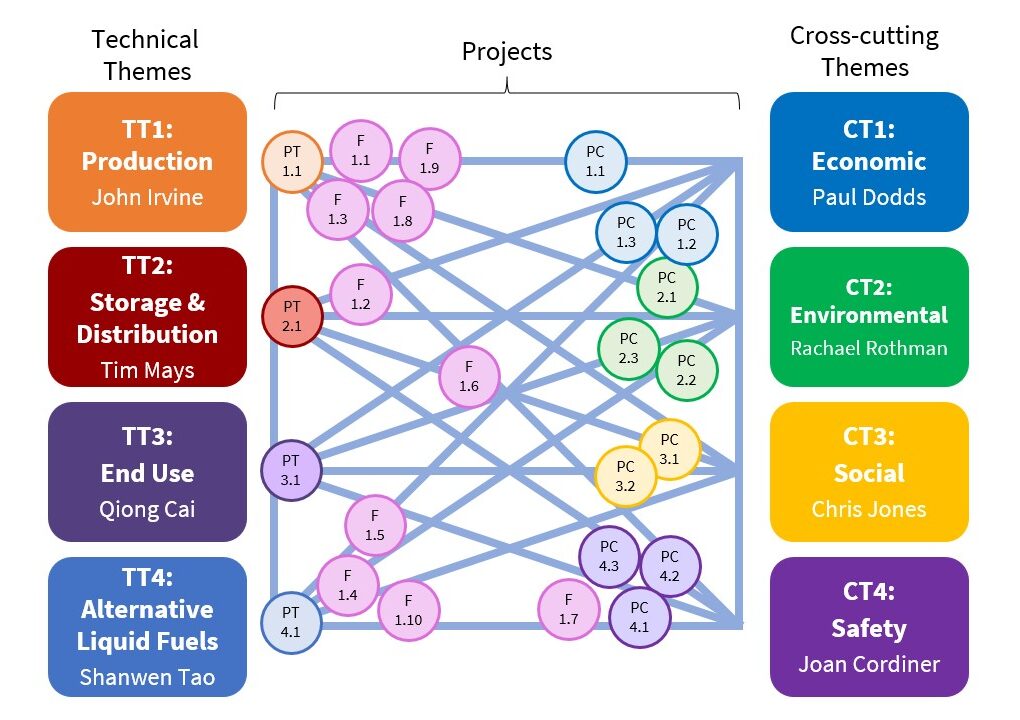
Successful proposals will be integrated into the existing research programme to deliver novel solutions to enable the wider adoption of hydrogen and hydrogen-based liquid fuels to decarbonise the UK economy. The Hub includes fifteen core projects (Figure 1, PT 1.1 – PT4.1, PC1.1 – PC4.3) already funded by EPSRC through the initial proposal. These are complemented by the first group of 10 Flex-funded projects (F1.1 – F1.10). Information about these projects and the broader UK-HyRES research portfolio is available at: https://ukhyres.ac.uk/research.
Projects in each Technical Theme are guided and informed by each of the Cross-cutting Theme Leaders, to ensure appropriate consideration of techno-economics, environmental and societal impacts, and safety.
New projects are required to align to either one of the Hub’s four technical themes TT1–TT4 or one of the four cross-cutting themes CT1–CT4 (as illustrated in Figure 1). Projects should also align to at least one secondary theme so that all research has primary and secondary alignment to at least one Technical (TT) and at least one Cross-cutting (CT) research theme category.
Stage 1 – Expressions of Interest (EOI)
Stage 1 is a call for Expressions of Interest, EOI (deadline for submissions 26 January, at 09:00hrs BST). EOIs are to be submitted electronically via completion of an EOI form, which is made available on MS Form.
EOIs will be assessed by the Theme Leads, members of the Strategic Advisory Board and invited external reviewers, based on criteria 1 to 4 as set out in Section 3.4 of the call document. EOIs shortlisted to proceed to the second stage will receive an invitation to submit a full proposal. Due to the volume of applications expected, there will be no feedback provided to applicants who do not proceed past the EOI stage.
Stage 2 – Full Proposal
Invited full proposals received (deadline for submissions hrs GMT) will go through a .
Proposals will be assessed based on criteria 1 to 5, as set out in Section 3.4 of the call document linked below. Second stage proposals should consist of the following evidence:
Part I:Project details – using the template provided – named “<PI surname>_Part_I”.
Part II:Case for Support including, a project title and a project description comprising clear identification of the research challenge/s the proposal is looking to address, novelty and timeliness, aims and objectives, programme of work including methodology, management including integration into UK-HyRES Hub, impact and dissemination – using the template provided with 3 pages maximum, named “<PI surname>_Part_II”
Part III: Track Record and Justification of Resources (JoR) which includes requested resources and industry support – using the template provided with 2 pages maximum, named “<PI surname>_Part_III”.
Official signed and dated letters of support from project partners, including a statement of the financial value of support offered (cash/in-kind) – named “<PI surname>_partner_<partner name>.
Researcher CVs – up to two A4 sides for each named researcher, named “<PI surname>_cv_<researcher_surname>.
Second stage full proposals should be submitted with the form below. Supporting document files can be provided in Word (.docx) or PDF (.pdf) format and emailed to UK-HyRESadmin@bath.ac.uk, with the subject line: “UK-HyRES Hub Flexible Funding Call Round 2 – ‘Proposal Name”.
Parts I, II and III and project partner letters of support should be submitted as individual documents in PDF format.
Process: Where applicants are unsuccessful after stage 2, feedback will be provided in writing within 28 working days of the final decision. Any feedback will be for information only; there will be no opportunity to discuss or appeal the decision.
Review Panel
Invited proposals will then be submitted to a review panel, including Hub Investigators and members of the Strategic Advisory Board. Peer reviewed proposals at this stage will be shortlisted by the panel against criteria 1 to 5 (listed below) and ranked to select the final research proposals that will receive the Flexible Fund Awards. Final award decisions by the Hub’s Management Board will be made mainly using the resulting panel ranked order.
Proposals will be reviewed on:
Quality, ambition and novelty and/or impact (Research could be blue sky or translational)
Strength of partnership and contributions
Ability to deliver the research and complete within the time and resources requested
Clear plans for proposed research, project management, engagement, EDI, skills development and impact
Terms and Conditions
Terms and conditions of standard UKRI FEC grant awards apply and can be viewed here.
All project outputs and engagement should be branded as ‘UK-HyRES Hub’. Brand materials and guidance will be provided to successful applicants.
For published outputs EPSRC reference EP/X038963/1 must be quoted.
Salary budget requested should be at a level commensurate with applicant’s skills, responsibilities, expertise and experience.
Whilst this fellowship scheme provides the opportunity for the applicationt’s development and dedicated time to focus to their own programme of research, it should not be construed as providing a guaranteed route to promotion. Applications should consult with their Host Institution’s HR Department and their Researcher Promotion Policy in this regard.
Equality, Diversity, and Inclusion
The UK-HyRES Hub supports the UKRI Key Principles of Equality, Diversity and Inclusion:
Equality, diversity, and inclusion (EDI) is a critical aspect of a healthy research culture – how projects are designed, carried out and who is involved.
Research and innovation should be ‘by everyone, for everyone’ – a dynamic, diverse, and inclusive research and innovation system in the UK is an integral part of society and should give everyone the opportunity to participate and to benefit.
We need to be diverse to accommodate that research and innovation is unpredictable, is often created through new and unanticipated combinations, and can take many forms.
By recognising and nurturing all people in the system and diversifying interactions, we will enrich our lives by creating knowledge, enabling us to understand the world around us and empowering us to tackle the many challenges we face as individuals and as communities, nationally and globally.
The whole workforce are key contributors in the research and innovation system – from the lead researcher or innovator to those who keep the lights on or maintain the large infrastructure and equipment in our laboratories, small businesses or on our research vessels
By valuing all, we recognise that a diversity of ideas, opinions, knowledge, and people enrich our work and enlarges our knowledge economy