
UK-HyRES is committed to supporting the next generation of researchers in the field of hydrogen research and energy systems. We have developed an Early Career Research (ECR) Network provides a platform for early-stage researchers, PhD students, and postdoctoral fellows to connect, collaborate, and advance their careers in this rapidly evolving sector.
We recently sat down with the new Co-Chair of Network, Dr Selda Ozkan from the University of St Andrews, to find out about her work and her vision for the Network going forward.
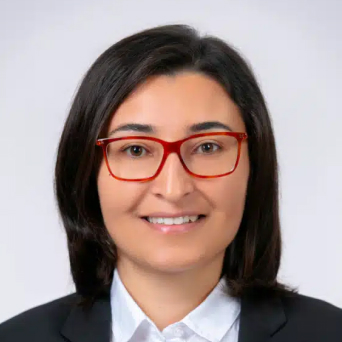
Tell us a bit about your research and background?
I received my PhD in Materials Science and Engineering from University of Erlangen-Nürnberg, under the supervision of Prof. Patrik Schmuki. My PhD research focused on PEMFC (proton exchange membrane fuel cell) systems, in collaboration with Toyota Motor Europe. I worked on developing nanostructured thin film electrode materials and assembling membrane electrode assemblies (MEAs) for PEMFC applications. After completing my PhD, I joined Prof. John Irvine’s group at the University of St Andrews.
My current research focuses on perovskite oxide exsolution materials, deposition techniques, nanostructured electrodes, and water electrolysis systems. If we look at current hydrogen technologies, precious metals still play an important role in both hydrogen production and utilisation technologies. In my research, I follow two main approaches to develop electrocatalyst material. The first is to minimise the amount of noble metals required by improving their dispersion and utilisation on perovskite oxide support materials. The second is to replace noble metals with earth-abundant, low-cost, and catalytically active non-precious metals.
The primary advantage of exsolution materials is their ability to yield uniformly distributed, ultra-fine nanoparticles (1–3 nm) with tailored sizes and densities. Strong anchoring to the oxide substrate provides robust catalyst–support interactions, which suppress migration or agglomeration during electrocatalyst usage/operation.
Why have decided to focus on the area of green hydrogen – what excites you about it?
We have a responsibility to use our knowledge and scientific understanding to help build a better world. If we continue with the way we live today, future generations may face increasing challenges related to air, food, and water quality, as well as access to essential resources.
I believe even a small contribution can make a big difference. This is one of the reasons I am interested in green hydrogen. Green hydrogen has the potential to contribute to a cleaner and more sustainable energy system, although there are still significant challenges in terms of cost, safety, infrastructure, and large-scale deployment. However, I believe we will see the full benefits of hydrogen more clearly in the long term, as these system-level challenges are gradually addressed.
Why were you motivated to become the ECR co-chair?
When the UK-HyRES project first started, there were only a few ECRs. Raj and Sibimol have done a great job in developing the ECR community, and we now have over a hundred members. As an ECR Co-Chair, I view my role as both an opportunity and a responsibility to support our community and contribute to its continued development.
Second, from a personal development perspective, I consider leadership as an important skill to develop. This role would give me the opportunity to gain more leadership experience, connect with more people across the Hub, and broaden my professional network.
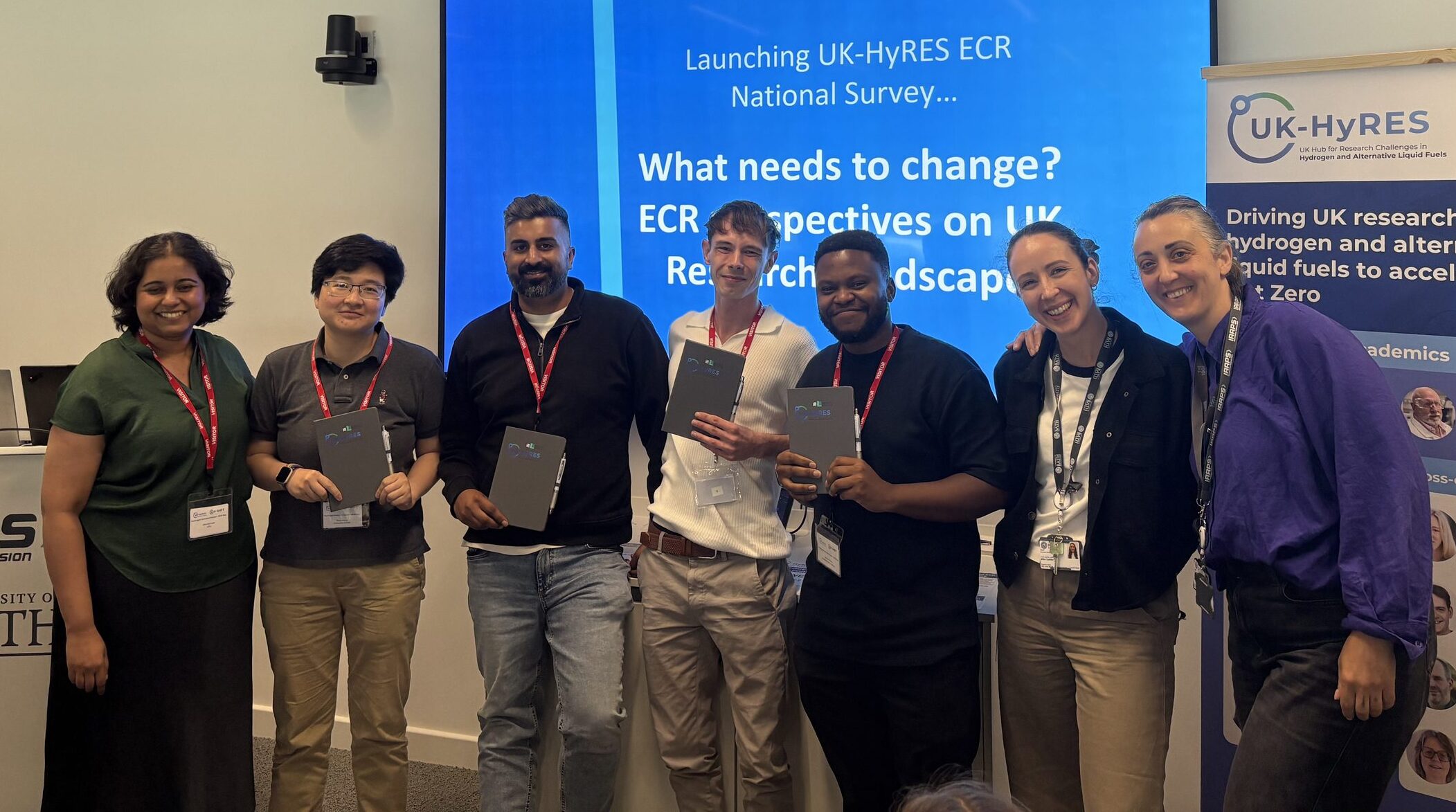
What are the key challenges face by ECRs in the hydrogen field at the moment?
There are two key challenges (in general) for ECRs now. The first is career stability. There are many highly skilled and talented researchers, but the number of permanent academic positions is limited, as a result some often face uncertainty and may eventually pursue opportunities in industry or other sectors.
The second is funding. Securing fellowships and research grants is a crucial part of developing an independent academic career, but competition is extremely high, with success rates sometimes below 5–10%. This makes it particularly difficult for ECRs to establish their own research programmes and build a long-term academic career in the field.
What are you hoping to achieve in your role?
My aim as an ECR Co-Chair is to build a supportive, friendly, and inclusive platform where ECRs can collaborate, develop their careers, and have their voices heard within the Hub. Also, I intend to grow the ECR community and expand our network by reaching out to researchers and academics in the hydrogen field, both in the UK and internationally.
Do you have some new initiatives in mind?
I am exploring the possibility of ECR open discussion & ideas sessions to establish informal discussion sessions that provide a supportive space for ECRs to share challenges, exchange ideas and experiences, and discuss topics relevant to their research and career development.
Can you share one piece of key advice or learning that has come out of your career so far that you would like to share with upcoming researchers?
I believe in the importance of resilience. Keep pursuing what you believe in, even when you cannot see the way forward. Sometimes, things do not work out as expected, but persistence can lead to something different or even better.
Find out more about the ECR Network: https://ukhyres.ac.uk/early-career-researchers/