
On 9 and 10 September, researchers, industry partners and funders met at the University of Warwick for the UK-HyRES Hub Research Board. Two days of talks, posters and discussion showed how far the Hub’s research has come, and why explaining its relevance to everyday life matters as much as the results themselves.
One message ran through the two days: hydrogen research needs to tell its own story. Researchers need to say how their work will be used, what difference it makes to people’s lives, and how it supports society and the economy. That theme surfaced in the opening plenaries, came back in the research updates, and shaped the workshop on the Hub’s future that closed the meeting.
Hearing from industry and funders
Two industry speakers described the challenges companies face in producing and delivering hydrogen. Dr Chris Kirk, Head of Fuel Cell Engineering at Intelligent Energy, explained how the company develops PEM fuel cell technology for a range of commercial uses. Dr Man Yi Ho, Research Programme Manager at SLB, presented a digital framework for making electrolysers more durable and efficient.
Federica Rizzi, Portfolio Manager at EPSRC, then set out the funding landscape and EPSRC’s priorities. She highlighted a clear trend towards research that is developed with industry and delivers value for both society and the economy.
From materials to public trust
In the afternoon, the Hub’s eight theme leads reported on progress. Their talks covered everything from the atomic scale to public opinion.
On the technical side, Professor John Irvine (St Andrews) described catalysts that could be refreshed inside an electrolyser rather than replaced, while using far less precious metal. Professor Mi Tian (Bath) showed how hydrogen confined in nanoscale pores can be stored densely at much warmer temperatures than liquid hydrogen. Modelling suggests a 3D-printed tank insert could hold around three times as much hydrogen as a conventional compressed tank. Professor Qiong Cai (Surrey) presented catalysts that remove harmful nitrogen oxides produced when hydrogen and ammonia are burned. Professor Shanwen Tao (Warwick) showed a room-temperature fuel cell that generates electricity while turning waste streams into useful products such as ammonia.
The cross-cutting themes asked whether these technologies would work in the real world:
- Economics: Paul Dodds unpicked why estimates of the cost of green hydrogen vary so widely.
- Environmental: Rachael Rothman’s team is developing guidelines so that hydrogen carbon footprints are transparent and comparable.
- Social acceptance: Dr Chris Jones (Portsmouth) found that eight in ten people in a regional survey supported underground hydrogen storage in principle, and that academics were the most trusted voices. He also cautioned that hype erodes trust.
- Safety: [Professor Joan Cordiner] described a toolkit that passes on decades of industrial experience in handling hydrogen safely to newcomers.
Professor Chris Brace, Director and Principal Investigator, UK-HyRES commented: “Day one showed how far the Hub has come. Hearing from Intelligent Energy, SLB and EPSRC alongside our theme leads was a valuable reminder that the challenges we’re working on are the ones industry and policymakers are facing right now. What stood out, was how well the technical and cross-cutting themes connect. Progress in materials and devices only matters if it’s affordable, sustainable, safe and trusted by the public, and that joined-up thinking is exactly what the Hub was set up to deliver.”
Projects in progress
Day two focused on the research the Hub funds directly. Six Flexible Fund (Call 1) teams gave updates on their projects:
- Dawei Wu: a low-emission burner fuelled with pure ammonia
- Terence Liu: low-energy ammonia synthesis
- Alex Walton: electrolyser catalysts that avoid iridium, one of the rarest metals on Earth
- Aidong Yang: using ammonia to make low-carbon iron for green steel
- Zeliha Ertekin: producing hydrogen from seawater
- David Book: hair-thin optical fibre sensors that detect hydrogen leaks in about a second
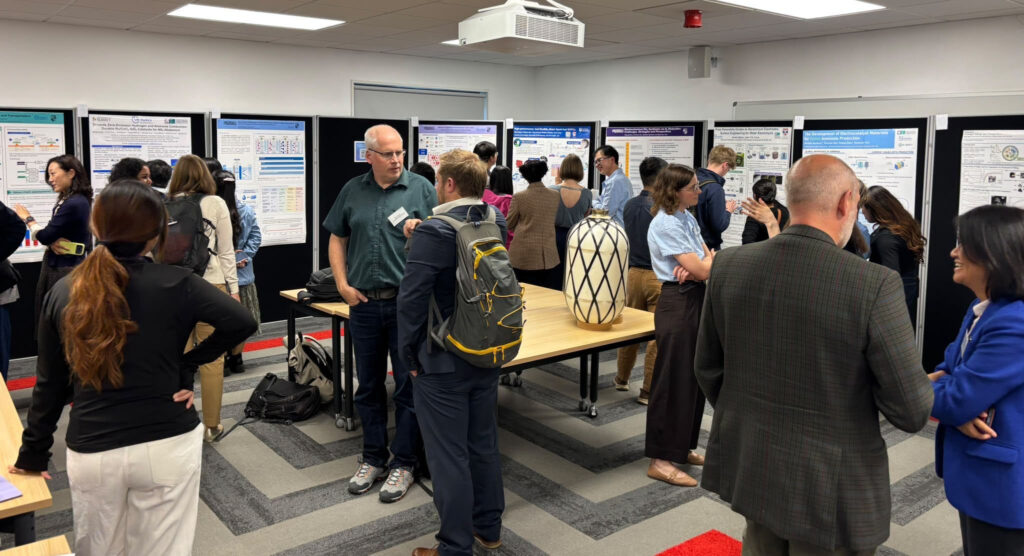
Twelve early-career researchers followed with three-minute flash talks on their UK-HyRES Fellowships and SPRINT projects. Topics ranged from George Neville’s glowing coatings for monitoring liquid hydrogen tanks, to Jordan Davies’s work on bringing ammonia into existing industrial boilers, to Shiqi Huang’s purification membranes made in seconds at room temperature. Connor Sherwin, Linlin Yang, Luke Woodliffe, Rajan Jagpal, Sepideh Aliasghari, Shu Wang and Yang Li also presented.
Looking ahead
The Hub launched its fourth Flexible Fund call at the meeting.
Finally, delegates participated in a workshop on the future of the Hub, including:
- strengthening its policy engagement and international reputation
- helping accelerate deployment
- developing skills that meet industry’s needs and support early- and mid-career researchers
- deepening its work with industry.
Karen Brooks, Deputy Director, UK-HyRES summed-up with: “The energy in the room during the flash talks was fantastic. It was a real showcase of the talent we’re developing across our early-career community. Launching Flexible Fund Call 4 and spending the afternoon thinking about the Hub’s future gave us a clear sense of direction. Above all, the two days reinforced how important it is that we explain what our research means for people’s everyday lives, and how it will support society and the economy. That’s a conversation we want everyone in the Hub to be part of.”