
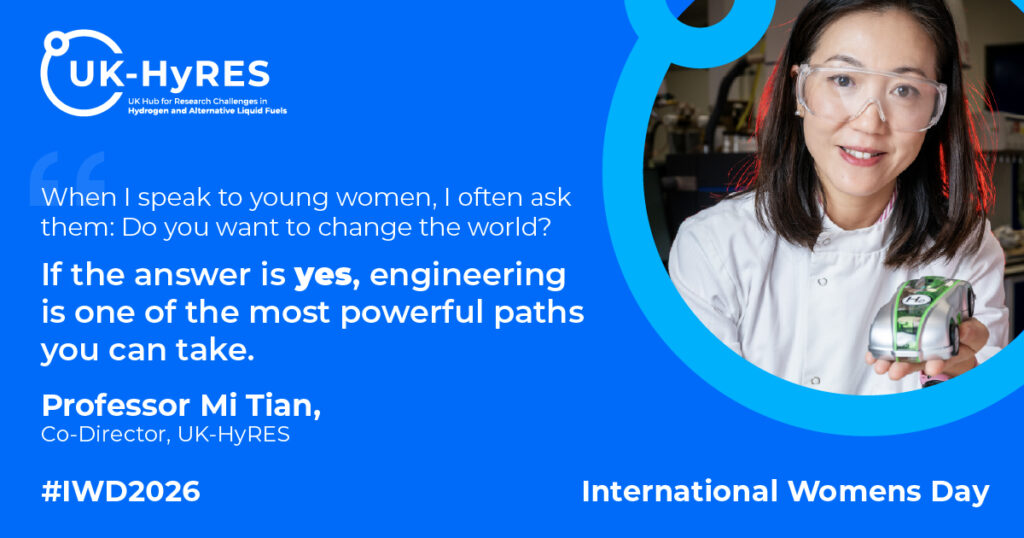
On International Women’s Day, Professor Mi Tian, Professor of Sustainable Hydrogen Energy at the University of Bath and Co-Director of UK-HyRES, gives her reflections on her career as a woman in engineering and what needs to be done to encourage and support more women into STEM.
Science has always been driven by curiosity for me. When I first started studying chemistry, I was fascinated by how it revealed the invisible world, how molecules and atoms form the matter around us. It felt like discovering a hidden layer of reality, and that curiosity quickly became a passion.
Later, my interest moved towards energy systems, particularly hydrogen energy. Growing up, my community sometimes had limited access to electricity and experienced power cuts. Those moments made me realise just how essential energy is to modern life. It shapes everything, how we live, work and develop as a society.
That experience stayed with me and ultimately guided my decision to focus my career on energy systems. I wanted not only to understand the science, but also to help solve real-world problems. My work in hydrogen energy is driven by both that early curiosity and a desire to contribute to solutions that matter.
The power of mentorship
Throughout my career, I’ve been incredibly fortunate to be supported and inspired by many female scientists and professionals. Mentorship has played a crucial role in my journey. These role models showed me what was possible and helped me navigate the challenges of academia and engineering.
Some of these women I remember clearly, others I met only briefly but still left a lasting impact. They shared their experiences, encouragement and support at key moments in my career. I often felt I had no way to repay them at the time, but I eventually realised that the best way to honour their support is to pass it on.
Now, I try to do the same for the younger generation, sharing that encouragement, energy and belief that they too can succeed.
Finding your voice in engineering
I describe myself as an engineer rather than a scientist. I trained in chemical engineering, which is a field where women are still significantly underrepresented. In the UK, women make up only around 16–17% of the engineering workforce.
Like many women in STEM, I’ve experienced moments where I had to work harder to have my voice heard, to convince others, or to be recognised for my ideas. Even in classrooms, female lecturers can sometimes find themselves needing to put in extra effort to persuade or engage students in male-dominated environments.
Confidence can also be a challenge. Studies often show that women are more likely to question themselves or hesitate before taking opportunities. I recognised this early in my career and made a conscious effort to challenge it.
Sometimes I still ask myself, “Am I ready? Am I good enough?” But when those doubts appear, I try to push past them and take the opportunity anyway. I remind myself: what’s the worst that could happen? Sometimes things go well, sometimes they don’t, but every time I step outside my comfort zone, I gain confidence and resilience.
One message I always share, especially on International Women’s Day, is simple: don’t wait until you feel ready.
What leadership means to me
For me, leadership isn’t about individual success. A good leader enables others to succeed.
That means creating an environment where people feel supported, included and valued, a place where they feel confident sharing their ideas. I’ve learned that simply giving everyone the same opportunity isn’t always enough. Often, women or minority voices may hesitate to speak up in open discussions.
Sometimes leadership means actively inviting those voices into the conversation, asking directly, “What do you think?” or “Do you have any suggestions?” When you do that, you often discover some of the best ideas in the room.
Progress and work still to do
Over the course of my career, I’ve seen encouraging progress for women in engineering, especially in the UK. More women are entering STEM fields, becoming chartered engineers and pursuing postgraduate research.
Through my involvement with equality, diversity and inclusion committees, I’ve seen the numbers slowly improving. Even a few percentage points increase in female undergraduate students can make a big difference for the future engineering workforce.
We’re also seeing more female leaders emerging, which is incredibly important. Representation matters: when young women see others succeeding in leadership roles, it shows them what is possible.
But we still have work to do. The baseline number of women in senior positions remains relatively low. Progress is happening, but it must continue.
Engineering can change the world
When I speak to young women considering engineering, I often ask them one question: Do you want to change the world?
If the answer is yes, engineering is one of the most powerful paths you can take. Technology and engineering have the potential to solve many of the challenges we face today, from climate change to energy security.
Right now, my research focuses on hydrogen energy, particularly hydrogen storage and transportation. We are approaching a tipping point where hydrogen could significantly reshape the global energy landscape.
It’s both exciting and daunting. Moving technologies from research into real-world deployment requires new skills, scaling systems, working with industry and bringing innovations to market. As researchers and engineers, this is something we are still learning, but it’s an incredibly exciting journey.
Why International Women’s Day matters
International Women’s Day is both a celebration and a reflection.
It celebrates the achievements of women, recognising the contributions they have made across science, engineering and many other fields. At the same time, it encourages us to reflect on the progress still needed.
My hope for the future is simple: that gender will no longer be a barrier to opportunity in science and engineering.
That means seeing more women in leadership roles, stronger support systems for balancing careers and family life, and a culture where everyone can contribute and succeed regardless of gender.