
SPRINT Spotlight
Connor Sherwin, University of Oxford
Project: Tracking Electrochemical Degradation in PEM Water Electrolysers
SPRINT Spotlight
 Connor completed his PhD at the University of Southampton Department of Chemistry in 2024 with Professor Andrea Russell. His PhD focused on designing a spectro-electrochemical cell for operando XAS measurements of gas-evolving and gas-consuming reactions. This work focused on characterising state-of-the-art catalysts for the oxygen evolution reaction, carbon dioxide reduction reaction and oxygen reduction reaction.
Connor then joined the University of Oxford as a postdoctoral researcher in September 2024, with his work focusing on the development of novel capabilities for operando X-ray measurements of various electrocatalytic systems. Primarily, he is interested in understanding the operating mechanism of highly active alkaline O2 evolution reaction catalysts and the selectivity of CO2 reduction catalysts.
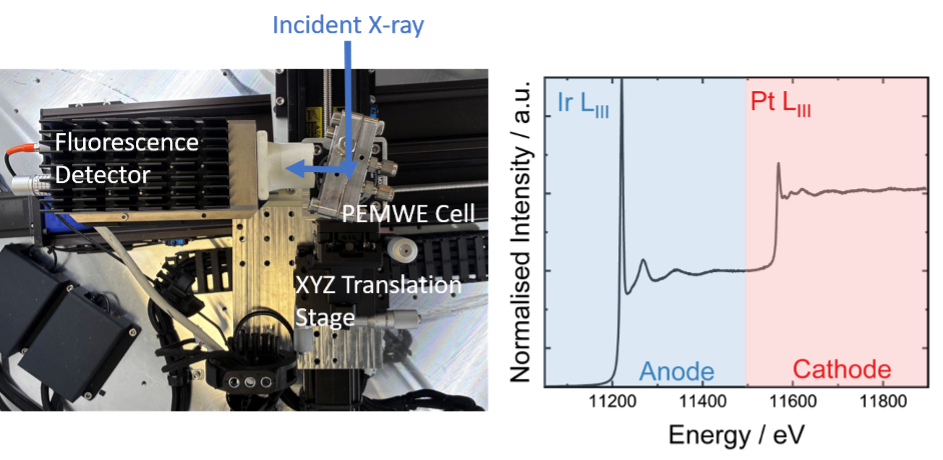
“This project investigates how iridium oxide catalysts degrade in proton exchange membrane water electrolysers (PEMWEs), an important technology for producing low-carbon hydrogen. During operation, iridium catalysts at the anode can undergo structural changes that reduce the active catalyst area, lowering electrolyser performance and increasing the amount of iridium required in the anode catalyst layer.
“The research will combine an operando PEMWE cell with a laboratory-based X-ray absorption spectroscopy system. This will allow changes in the catalyst’s oxidation state and local structure to be monitored over long periods while the electrolyser operates under realistic constant and dynamic load conditions that mimic the intermittency of renewable electricity. Electrochemical performance data will then be correlated with time-resolved structural changes in both the iridium anode catalyst and the platinum cathode to better understand the origins of performance loss.
“The project aims to distinguish reversible catalyst restructuring from irreversible degradation, identify the operating conditions that accelerate performance loss, and establish clear relationships between catalyst structure and device performance. The findings will support the development of more durable catalysts with lower iridium loadings, extend electrolyser lifetimes, and help reduce the cost of green hydrogen production.”
Connor Sherwin, University of Oxford