
SPRINT Spotlight
Linlin Yang, University of Oxford
Project: Enabling Zero-Carbon Ammonia Engines through Multiple Spark Ignition
SPRINT Spotlight
 Dr Linlin Yang is a Postdoctoral Research Assistant at the University of Oxford, specialising in zero-carbon propulsion and computational combustion. His current research uses high-fidelity simulations to investigate ammonia and hydrogen combustion in laminar and turbulent flows, with a focus on optimising engine design and mitigating combustion hazards. His work supports the safer and more effective use of ammonia and hydrogen in future zero-carbon propulsion systems and infrastructure.
Building on this expertise, his SPRINT project, “Enabling Zero-Carbon Ammonia Engines through Multiple Spark Ignition Systems,” explores novel methods for using ammonia, including ammonia–hydrogen blends and multiple spark ignition systems, in advanced engines. By developing more reliable ignition approaches, the project aims to overcome a key barrier to efficient ammonia combustion and accelerate the development of practical zero-carbon engines.
“Hydrogen and ammonia are promising low-carbon fuels that can play a key role in achieving net-zero emissions. My SPRINT-funded project aims to support the safe, clean, and efficient use of these fuels in next-generation energy conversion and power generation systems.
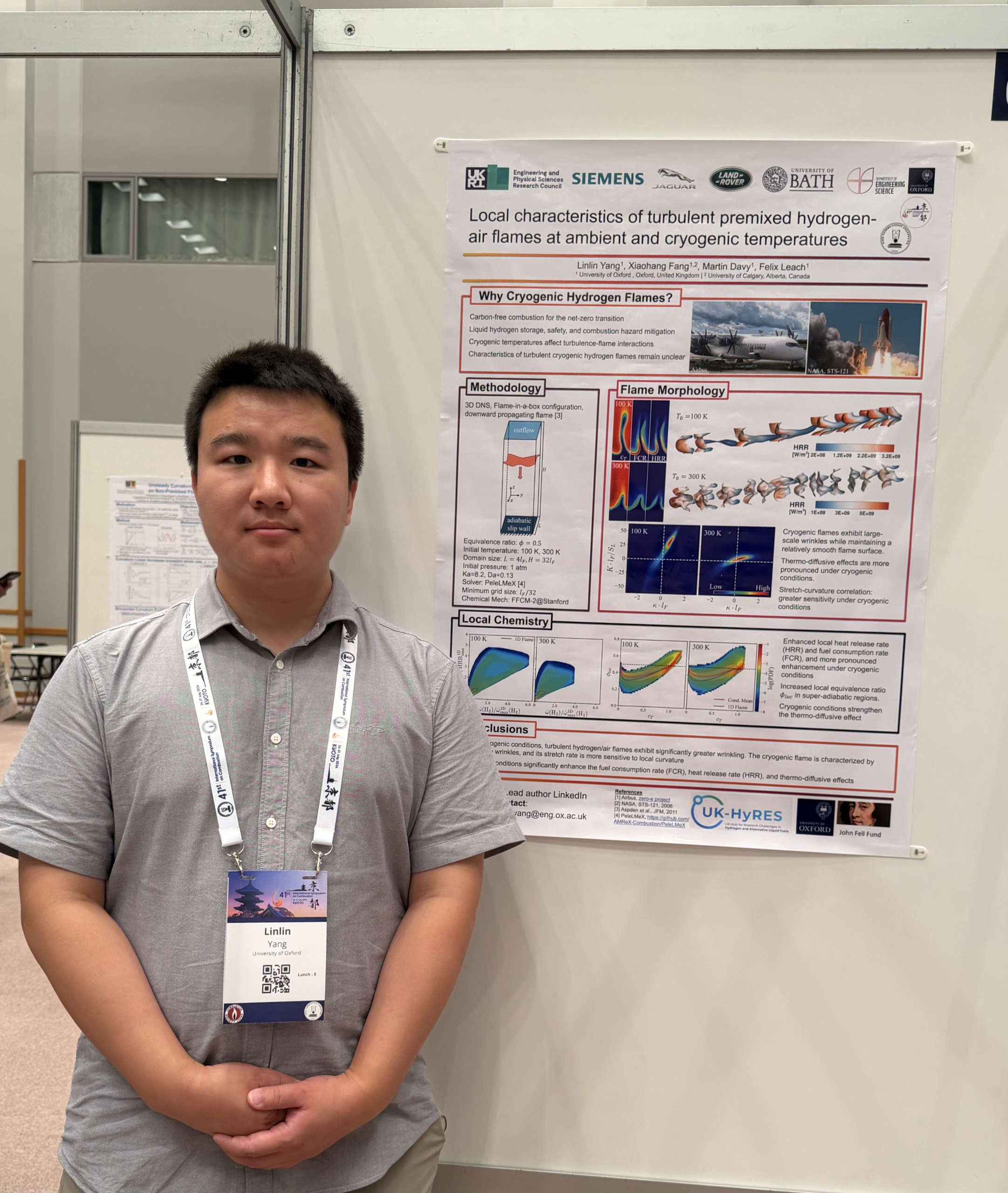
“My research focuses on understanding the combustion behaviour and safety risks associated with hydrogen and ammonia, helping to ensure these emerging energy technologies can be deployed safely and reliably. The accompanying poster, presented at the 41st International Symposium on Combustion (ISOC) and supported by the SPRINT Award, highlights research into the safety management of liquid hydrogen systems. The work demonstrates that combustion of cryogenic hydrogen-air mixtures can be significantly intensified by intrinsic flame instabilities and turbulence compared with combustion under ambient conditions.
“These findings provide new insights into the mechanisms governing hydrogen fires and explosions and contribute to the development of improved hazard mitigation strategies. Ultimately, the project will help enable the wider adoption of hydrogen and ammonia as safe and sustainable energy carriers for a low-carbon future.”
Linlin Yang, University of Oxford