
SPRINT Spotlight
Rajan Jagpal, University of Bath
Project: HySPIN: Spin-Isomer and Adsorption Interactions in Hydrogen Systems
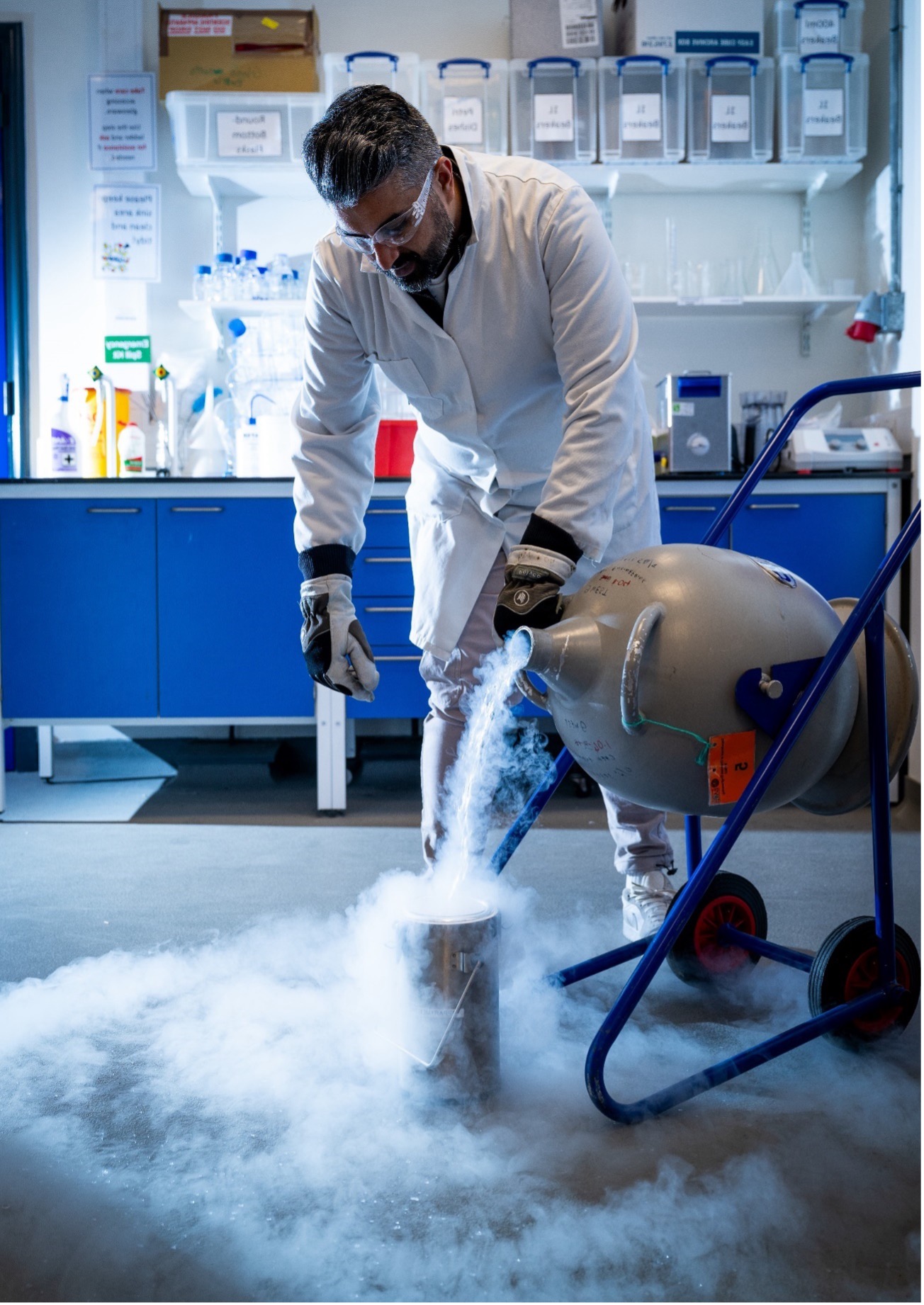
SPRINT Spotlight
 Dr Rajan Jagpal is a postdoctoral researcher at the University of Bath, where he leads experimental and modelling work on solid-state hydrogen storage as part of Project PT2.1: Solid-state hydrogen storage materials for aerospace applications, in collaboration with Professor Tim Mays within the UK-HyRES Hydrogen Research Hub. His work focuses on the development of advanced nanoporous materials and structured composites to store hydrogen safely and efficiently under the cryogenic and high-pressure conditions required for zero-emission aircraft.
Rajan combines expertise in material characterisation, thermodynamic modelling, and process engineering to understand how hydrogen interacts with porous solids at the molecular level. He has refined adsorption models, including a modified Tóth isotherm, to more accurately describe storage behaviour at low temperatures, with results showing local hydrogen densities exceeding that of liquid hydrogen. He helped establish the high-pressure hydrogen lab at Bath, commissioning key equipment and leading infrastructure development to support this research.
His background spans mechanical engineering, applied mathematics, and aerospace materials. Rajan completed his PhD in composite forming at Bath under the supervision of Dr Evros Loukaides, Professor Richard Butler, and Dr Vangelis Evangelou, supported through the SAMBa Centre for Doctoral Training and part-funded by GKN Aerospace. His doctoral research developed real-time predictive models of complex composite deformation, using Bayesian machine learning to link process physics and experimental data.
Alongside his technical work, Rajan contributes to national research strategy through the UK-HyRES Hub, working with academic and industrial partners such as GKN Aerospace and IAAPS. He led a recent cross-sector review paper on cryogenic hydrogen storage for aviation and has helped shape priorities across multiple hydrogen initiatives. His research sits at the interface of fundamental science and practical deployment, supporting the transition to net-zero technologies in transport and energy.
“Cryogenics quietly underpin modern life, supporting technologies ranging from MRI scanners and semiconductor manufacturing to food production, spaceflight and energy systems. Low-carbon liquid hydrogen could also enable lower-emission aviation. Hydrogen contains no carbon, offers exceptionally high energy per unit mass and, in its liquid form, allows more hydrogen to be stored within a given volume than compressed gaseous hydrogen. It may also provide useful cooling potential for wider aircraft thermal management.
“Realising these advantages requires us to understand cryogenic hydrogen as part of a dynamic energy system, not just as a liquid contained in a tank.
“HySPIN will investigate one of hydrogen’s most intriguing molecular properties: its existence as two spin isomers, orthohydrogen and parahydrogen. As hydrogen is cooled, conversion from the higher-energy ortho form to the lower-energy para form releases heat and must be carefully managed during liquefaction. Much less is known about how spin composition subsequently evolves as cryogenic hydrogen encounters metals, oxides, porous materials and changing operating conditions throughout storage, transfer and fuel delivery.
“Supported by GKN Aerospace and Molecular Products, HySPIN will develop new experimental approaches and generate system-relevant data to determine whether, when and where spin-isomer effects matter. This knowledge could support more effective control of cryogenic hydrogen and better-informed choices about materials and system architecture, helping to enable safer, more efficient and more sustainable cryogenic hydrogen technologies.
“Leading HySPIN is an exciting opportunity for me, particularly as my first independently led research project. The project grew from questions that emerged during our recent review of liquid-hydrogen systems, highlighting how much there is still to understand about the way fundamental science influences practical engineering. I’m looking forward to working with our academic and industrial partners to explore those questions and generate evidence that can support future cryogenic hydrogen technologies.”
Rajan Jagpal, University of Bath