
SPRINT Spotlight
Sepideh Aliasghari, University of Manchester
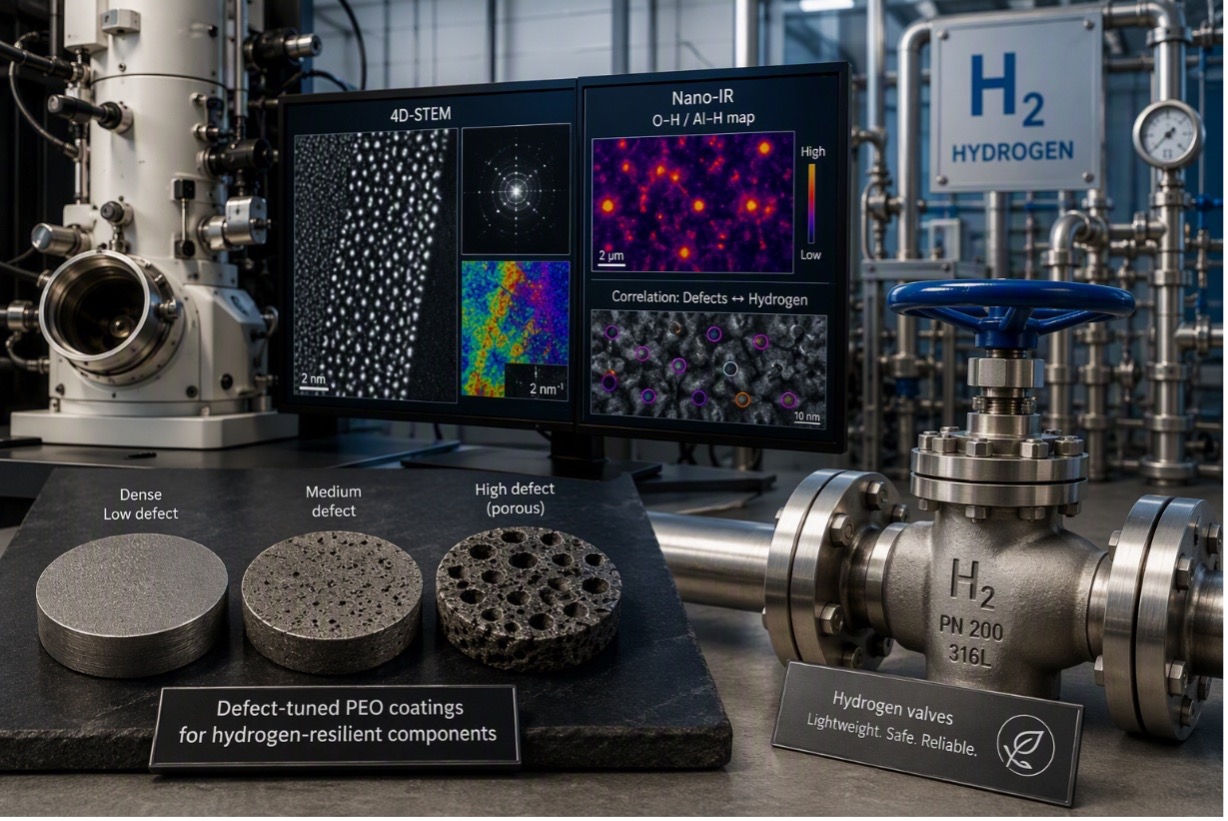
Project: Defect-Tuned Plasma Electrolytic Oxidation (PEO) in Hydrogen Charged Environment, Open New Path for Hydrogen Valves
SPRINT Spotlight
 Dr Sepideh Aliasghari earned her bachelor’s degree in Chemistry and a master’s degree in Materials Science and Engineering from Sharif University of Technology. She completed her PhD in Corrosion and Protection (Materials Science) at the University of Manchester in 2014. Following her doctorate, she was recognised with an award from the Iranian National Elite Foundation and served as an adjunct lecturer at Sharif University. Additionally, she has gained valuable industrial experience over the years.
Dr Aliasghari joined the UKRI-STFC Daresbury Laboratory after receiving a Marie Skłodowska-Curie Research Fellowship under the European Union’s Horizon 2020 Research and Innovation programme (2017–2019). In 2020, she was endorsed as a Global Talent by the Royal Academy of Engineering. That same year, she became a member of the scientific team at the Iranian Light Source Facility (ILSF-IPM).
In 2021, Dr Aliasghari began her role as a Research Associate at the University of Manchester under an EPSRC-funded project. She also serves as an Application Scientist at the Henry Royce Institute for Advanced Materials and is a Visiting Research Fellow at Manchester Metropolitan University.
Her research focuses on surface treatments and coatings for lightweight metals with porous morphologies, offering significant potential for various engineering applications. Dr Aliasghari is dedicated to developing innovative protection treatments that enhance long-term performance, particularly in corrosion and tribology. Additionally, she specialises in advanced characterisation techniques to gain a deeper understanding of degradation mechanisms.
“Hydrogen is expected to play a vital role in achieving net-zero emissions, but its interaction with engineering materials can cause degradation, creating challenges for the safe deployment of hydrogen technologies. Through a UK-HyRES SPRINT-funded project, Sepideh Aliasghari is investigating how advanced ceramic coatings produced by Plasma Electrolytic Oxidation (PEO) behave in hydrogen-rich environments. The research focuses on lightweight aluminium and titanium alloys that could replace heavier stainless-steel components in hydrogen valves, regulators, and storage systems, improving efficiency and reducing weight.
“The project combines two cutting-edge characterisation techniques, four-dimensional scanning transmission electron microscopy (4D-STEM) and Nano-IR spectroscopy to study, for the first time, how hydrogen interacts with defects inside PEO coatings at the nanometre scale. By revealing where hydrogen is trapped and how it influences phase transformations and degradation processes, the research aims to establish fundamental design principles for hydrogen-resistant coatings.
“The findings will support the development of safer, more durable materials for the hydrogen economy, while strengthening UK capability in advanced microscopy and hydrogen materials research. The project is expected to provide valuable evidence for future industrial adoption of lightweight hydrogen-compatible components and inform larger collaborative research programmes in clean energy technologies.”
Sepideh Aliasghari, University of Manchester