
SPRINT Spotlight
Shu Wang, University of St Andrews
Project: Next-Generation Green Methanol: Enhancing Biogas Conversion through Solid Oxide Cells
SPRINT Spotlight
 Dr Shu Wang completed his M.Sc. degree in Material Science & Engineering from Sun Yat-Sen University, China, in 2017, where he worked on developing novel ceramic oxygen permeation membranes and exploring dual-phase membrane materials for CO2 capture.
Later on, his research interest shifted to solid oxide cells. In October 2020, Shu joined DTU Energy (Technical University of Denmark) as a PhD candidate under the supervision of Bhaskar Reddy Sudireddy and Peter Vang Hendriksen. During his PhD, he concentrated on the development of novel fuel electrodes for solid oxide cells. His work encompassed the design and synthesis of electrode materials and the optimisation of their performance using infiltration and exsolution techniques.
Furthermore, he scaled up these technologies to 5×5 cm cells. In the last year of his PhD, he went to Strathclyde University for a four-month exchange study under the guidance of Dragos Neagu. The research topic at this time was the design and modelling of new exsolution materials. In February 2024, he joined the JTSI group as a Postdoctoral Research Fellow. His main research interests now focus on Methanol Solid Oxide Fuel Cells in Marine Demonstrations.
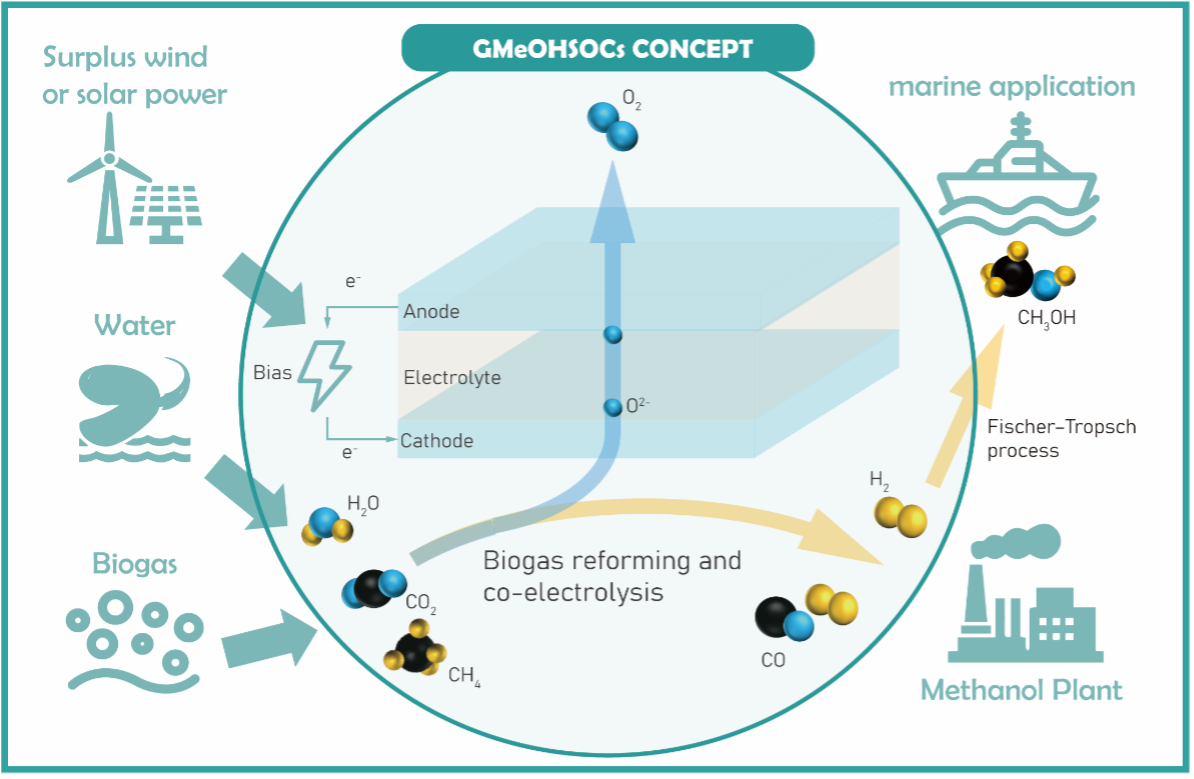
“This project explores a new electrochemical route for converting renewable biogas into hydrogen-rich syngas for green methanol production using solid oxide cell (SOC) technology. Conventional biogas-to-methanol processes require multiple energy-intensive reforming and gas separation steps, resulting in low carbon utilisation and limited methanol yields. The proposed approach integrates biogas–steam co-electrolysis with catalytic reforming within a single SOC, offering the potential to simplify the process while significantly improving carbon efficiency.
“The four-month project will establish the first experimental foundations for this concept by developing and evaluating exsolution-enabled perovskite fuel electrodes with anchored metal nanoparticles. These materials are expected to provide high catalytic activity, improved resistance to carbon deposition, and enhanced electrochemical performance under biogas–steam electrolysis conditions. Electrochemical testing will investigate the influence of operating conditions on syngas composition, with the aim of achieving the CO/H₂ ratio required for downstream methanol synthesis, while benchmark comparisons with conventional Ni–YSZ electrodes will assess performance advantages.
“The project will deliver validated electrode fabrication methods, initial electrochemical performance data, syngas optimisation strategies, and preliminary stability assessment. These outcomes will provide the essential scientific basis for future development of high-carbon-utilisation SOC technologies for sustainable green methanol production, supporting the decarbonisation of hard-to-abate sectors such as maritime transport.”
Shu Wang, University of St Andrews