
UK-HyRES researcher Dr Sibimol Luke recently presented research at the World Hydrogen Energy Conference (WHEC) in Singapore, one of the premier international events bringing together researchers, industry leaders, policymakers, and technology developers from across the global hydrogen sector.
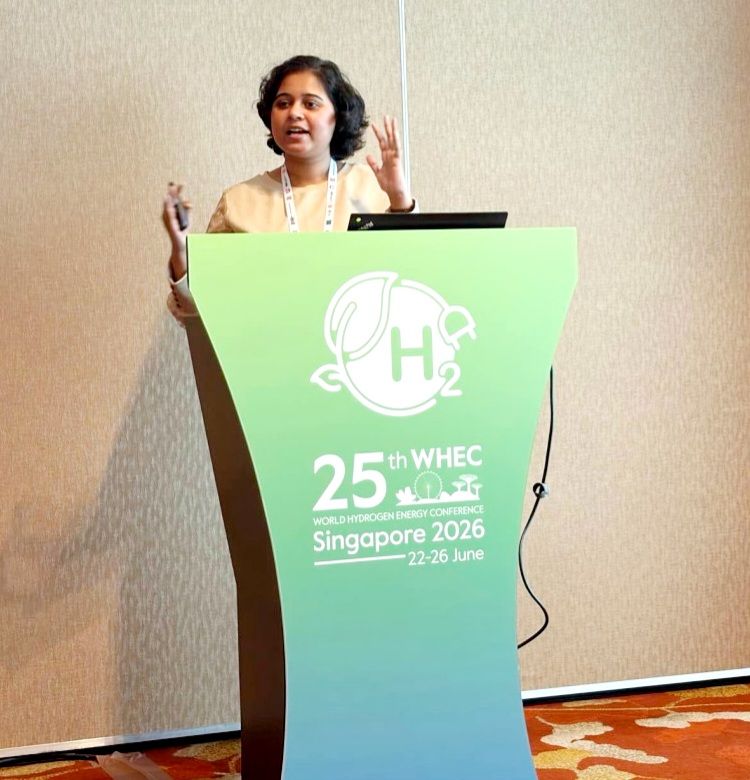
Held over five days, the conference provided a valuable platform for discussing the latest developments, challenges, and opportunities in hydrogen technologies. The event highlighted the importance of international collaboration in accelerating the transition to a low-carbon energy system, while also providing a forum for open discussions on the realities of scaling hydrogen production and deployment.
Representing UK-HyRES and The Bartlett School of Environment, Energy and Resources (BSEER), UCL, Sibimol presented research undertaken with Professor Paul Dodds entitled:
“Heat Integration and Cost Drivers in Solid Oxide Electrolysis: A UK Techno-Economic Perspective.”
The presentation explored the key factors influencing the Levelised Cost of Hydrogen (LCOH) produced through solid oxide electrolysis and examined how different technological and operational choices affect overall system economics. The work attracted considerable interest from conference participants and generated engaging discussions on the future direction of electrolyser development and hydrogen system design.
Several important findings emerged from the study:
- System flexibility has a greater impact on reducing hydrogen production costs than incremental improvements in technology performance.
- Component-level technological improvements exhibit diminishing returns beyond certain performance thresholds.
- System-level optimisation is becoming increasingly important for improving economic competitiveness.
- There is a fundamental trade-off between infrastructure costs and utilisation efficiency.
- Electrolyser utilisation is a key and often underappreciated driver of hydrogen production costs, with the frequency of operation proving just as important as electricity prices.
The research highlights a broader shift in focus within the hydrogen sector. While advances in individual components remain important, future cost reductions are increasingly likely to come from improving the design, integration, and operation of hydrogen systems as a whole.
Participation in WHEC provided an opportunity to showcase UK-HyRES research to an international audience, exchange ideas with leading experts worldwide, and contribute to discussions on the future role of hydrogen in achieving net-zero energy systems.
As the hydrogen sector continues to evolve, such international engagement helps ensure that UK research remains at the forefront of innovation and contributes to addressing the technical and economic challenges associated with large-scale hydrogen deployment.